
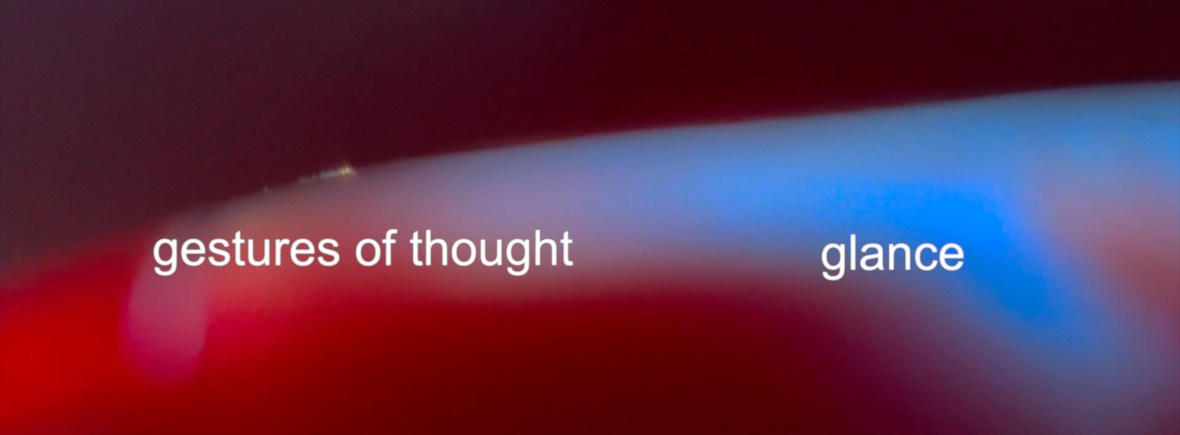
Eyes fluttering, a trembling hand, the blinking waves breaking on the shore – we will find series of shimmering close-ups like these constantly in Jean Epstein’s films. They all celebrate the fusion of human bodies with their surroundings, of gestures with thoughts, of time with space and all the elements of nature.
This is what Epstein meant by the term photogénie: the ability of the cinematic apparatus to capture an entanglement of our perceiving bodies and what they perceive, a “revelation on the screen of a deeper inner life, with its perpetual palpitation, its crisscrossing meanders, its mysterious spontaneity” (71-73). Photogénie describes these moments when we are at the same time fully enraptured by what we see. Yet, we experience our own bodies to the fullest in that process of perception. And by being equally dependent on the film camera’s ability to see like no human can, as on our uniquely human forms of perception, photogénie constantly crosses the separation between technological function and embodied life.
It is also what Eliza Steinbock means by their concept of the „shimmering image“: As the visual phenomenon of the shimmer that exists only in movement, in transition, the shimmering image „opens a line of escape from thinking in set binary oppositions by grasping the ongoing event of differential becomings“ (4). The shimmering image thus becomes a form to think trans-personality. At the same time it is pointing to the fundamental aesthetic and technological characteristics of the audiovisual medium with its flickering images and blinking pixels. „The radical antistatic status of shimmering suggests a suspension of being either really there or not there, of being fully graspable. To become situated, or to situate oneself, in the shimmering of these boundaries opens up another way of knowing that does not rely on visual certainty“ (17).
This helps me better understand these moments of shimmering in the films of Jean Epstein as the oeuvre of a queer artist, as a poet of change and becoming, and also my own footage made with a camera through my fingers on a sunny autumn day, long waiting in an archive. When I looked at this footage again, I fell in love with how it celebrates the distinct qualities of an optical machine, all these lens flares and blurs, all these shimmers that make me sense my body so acutely, while no longer positioning me as a fixed identity but rather as body in change, as a body of transitory, shimmering experience.
And my footage pointed me back to all these innumerable sequences from Epstein’s films, all these glances, in which cameras and characters meet, in which objects and people converge, change, and look at each other, in which audience and screen touch.
The English word „glance“ sounds strikingly similar to the German „Glanz“ – which means „glimmer“ and „shimmer“ (one of the famous cases in Freud’s text „Fetishism“ hinges on that homophony).
The glances of cameras and characters produce these shimmers, within the images I watch, within my body that I feel.
- Jean Epstein, Le Cinéma du diable. Paris 1947.
- Eliza Steinbock, Shimmering Images: Trans Cinema, Embodiment, and the Aesthetics of Change. Durham 2019.
 Johannes Binotto / / / Transferences