

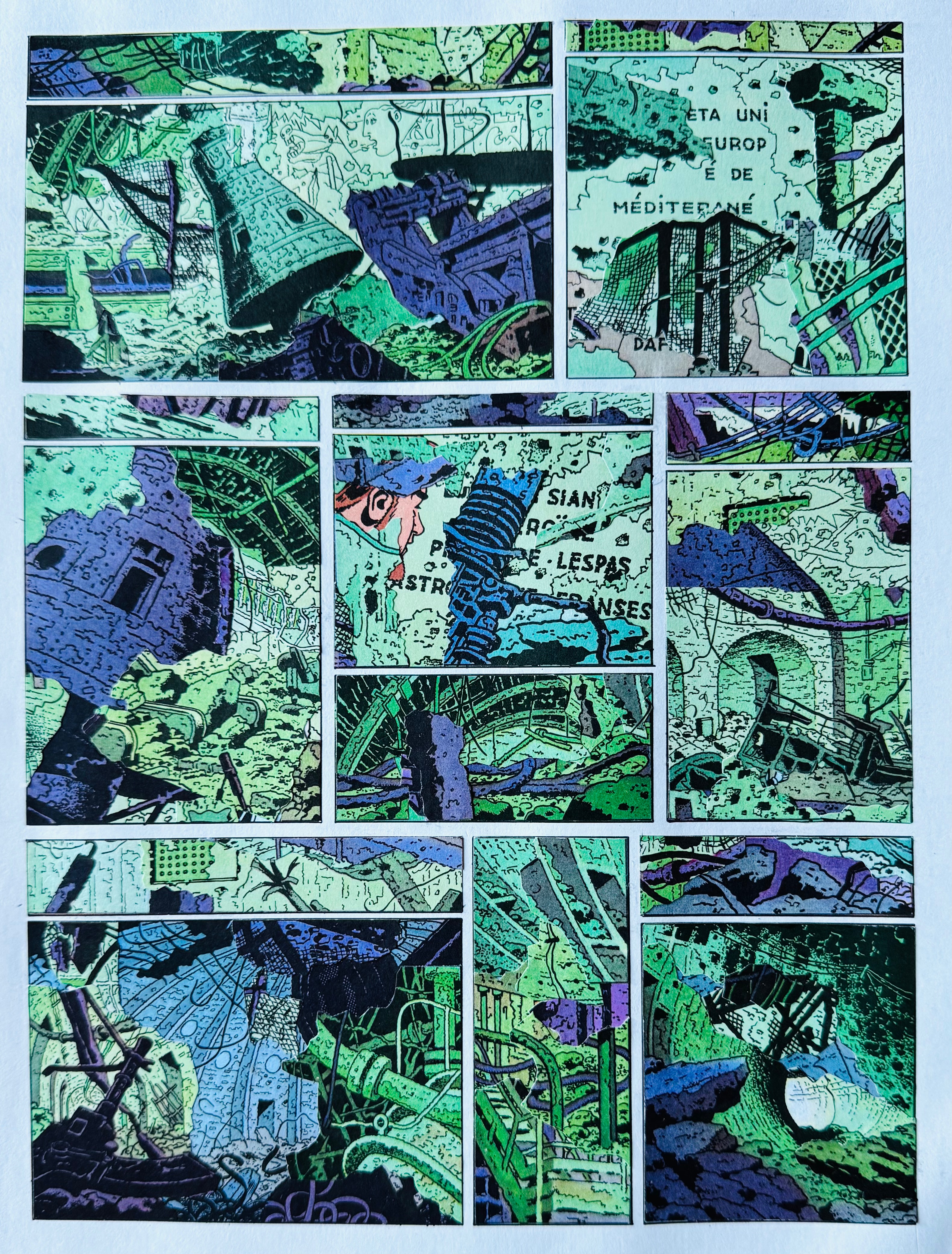
I still remember how I first lost myself in the pages 26 to 31 of Edgar P. Jacobs 1962 comic book „Le piège diabolique“: Our protagonist Professor Philip Mortimer in his treacherous time machine has traveled from the past to future. He is still in the same crypt where at the beginning of the book he first found the infernal machine. But once again everything is different. Everything is in ruins, a strange green glow is leading him from one destroyed cellar to the next. Broken concrete, cables and wires, destroyed nuclear plants and busted missile systems, obscure writings on the wall by beings long dead.
I remember how frightened I was and still am, seeing my hero stumbling through one rubble field after another, squeezing through openings, climbing shattered steel stairs, up and down. Losing his way through a cascade of endless spaces.
„How will he ever find his way back to the time machine that is his only hope for escape?“ I asked myself. And what I learned then and there is that the horror lies not in some monster waiting inside the labyrinth, but in the labyrinth itself. The prehistoric creatures or the medieval marauders that Mortimer faced earlier in the book – those are concrete adversaries that can be fought and overcome. But how do you fight an endless space? The perfect prison is one without walls, just endless passageways never leading out but only deeper and deeper inside. Space devours you, step by step.
I try to imagine how it must have felt to the readers who first read this adventure in its original serial form, published page by page from September 1960 to November 1961. And this sequence in particular, this horrific passage of six pages which I could easily skip over in my comic book, they had to be endured for over six weeks by its original readers. How anxious they must have felt, lost for one and a half month in an underground, where under every cellar is an other one.
The subterranean was Edgar P. Jacobs obsession. It is is were the dangerous treasure of „Le Mystère de la Grande Pyramide“ is hidden, it is were the mad scientists Dr. Septimus and Professor Miloch of „La Marque jaune“ and „S.O.S. Météores“ have built their machines to destroy us.
In his autobiography Jacobs tells the story of how he as a child of two or three years fell into an abandoned well, seven meters deep, rescued only after half an hour. „From that distant tragedy, I retain a few scattered images: first, at the level of my mouth, black, stagnant water on which bubbles and a few matchsticks were floating…“ (p.9) A future obsession is built here, mined into this ancient memory.
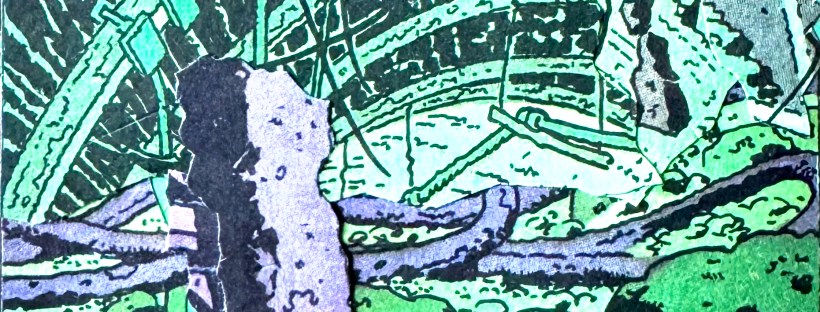
I keep coming back into these frightening underground spaces of Jacobs. I want to study them by making them even more endless, by collaging, condensing the six comic book pages into one. As the collage mixes up background and foreground so too the spaces become impossibly folded back into themselves. Where the original panels depicted depth, the collage keeps the eye constantly adjusting between the different planes of space pieced together in impossible proximity. The illusion space gives way a topology of the moebius strip where behind and in-front become indistinguishable: a non-oriented surface.
I understand the collage as a form of analysis and re-enactment at the same time. Never did I understand more clearly the visual technique of Jacobs, its tiniest details, better than when I started to cut these panels up, to follow and excavate traces and forms with my scissors. And in doing so, the exploration becomes a new visual architecture itself.
The collage is a study. And a prolongation.
What the collage tries to enact is what I experienced when I first entered „Le piège diabolique“. To never find my way out.
May 2026
Bibliography:
Edgar P. Jacobs: Un Opéra de papier. Gallimard 1981.

